Inaugural Session of the Two-Day International National Iqbal Conference 2026 Held Through Collaboration Between Women University Mardan and the National Language Promotion Department
Inaugural Session of the Two-Day International National Iqbal Conference 2026 Held Through Collaboration Between Women University Mardan and the National Language Promotion Department
“The development of a country cannot be viewed separately from its culture.”
— Mr. Aurangzeb Khan Khichi
“Iqbal’s poetry and philosophy remind Muslims of their greatness.”
— Prof. Dr. Razia Sultana
“Iqbal’s message continues to promote intellectual independence and human awakening in national life.”
— Prof. Dr. Muhammad Saleem Mazhar
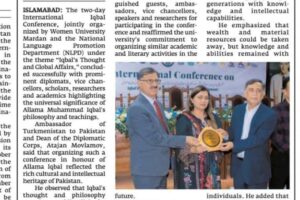
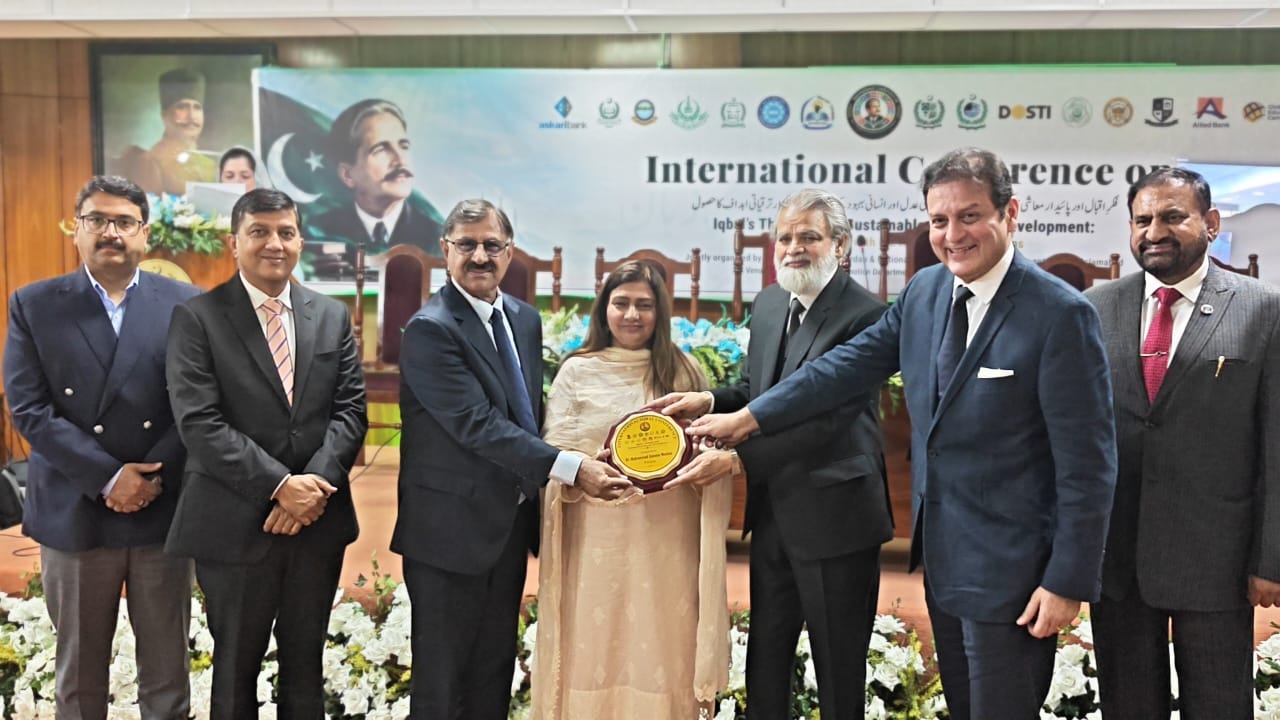
Islamabad (P.R.): The intellectual legacy of Allama Muhammad Iqbal is an integral part of Pakistan’s national and cultural identity. These views were expressed by Mr. Aurangzeb Khan Khichi while addressing the inaugural session of the Two-Day International National Iqbal Conference 2026, organized through the collaboration of the National Language Promotion Department (NLPD) and Women University Mardan.
He emphasized that effective measures should continue to be taken to convey Iqbal’s message to the younger generation through academic and literary activities. He further stated that sustainable development and economic prosperity could only be achieved by providing equal opportunities to young people and women. He remarked that the development of a country cannot be viewed separately from its culture. He also announced that the conference would not remain confined to the presentation of research papers; rather, its recommendations would be translated into practical initiatives with the support of the Higher Education Commission (HEC).
The inaugural session of the Two-Day International National Iqbal Conference 2026, organized by the National Language Promotion Department in collaboration with Women University Mardan, was held at Aiwan-e-Urdu, National Language Promotion Department, Islamabad. The conference was attended by distinguished academic, literary, research and diplomatic personalities. Participants shared their views on Allama Muhammad Iqbal’s philosophy, the concept of Khudi (selfhood), national identity, intellectual freedom and the relevance of Iqbal’s message in the contemporary era. The ceremony commenced with the national anthem, recitation from the Holy Quran and Naat-e-Rasool-e-Maqbool ﷺ, followed by a brief introduction to Women University Mardan.
In her welcome address, the Vice Chancellor of Women University Mardan, Prof. Dr. Razia Sultana, thanked the distinguished guests and stated that Allama Iqbal had great expectations from the younger generation and consistently taught them the lesson of Khudi (selfhood). She observed that Iqbal envisioned a separate homeland for Muslims, and Pakistan represents the realization of that dream. She further stated that Iqbal’s poetry reminds Muslims of their greatness, while his lectures introduce us to the true spirit of Islam.
Drawing comparisons with renowned historical personalities, she remarked that just as Omar Khayyam was both a poet and mathematician and Ibn Khaldun was a philosopher, Allama Iqbal was not only a poet but also a thinker, philosopher, economist and legal scholar. His poetry inspires self-confidence, self-awareness and a sense of purpose among young people, while his philosophy encourages them to remain connected to their cultural identity and advance in the fields of knowledge and research.
Explaining the objectives of the conference, Prof. Dr. Muhammad Saleem Mazhar, Director General, National Language Promotion Department, stated that its primary objective was to highlight Iqbal’s thoughts and philosophy in an international academic context and create new opportunities for research and intellectual dialogue. He emphasized that Iqbal’s message is not confined to a particular era; rather, it continues to promote intellectual independence and human awakening in national life. He described Iqbal’s message as a vital source of intellectual guidance for the younger generation.
He further highlighted that Allama Iqbal’s first book was Ilm-ul-Iqtisad (The Science of Economics), which presents valuable economic principles. He observed that economics is essential to human life and that economic well-being is also necessary for mental peace and stability.
Dr. Reza Amiri Moghadam, Ambassador of the Islamic Republic of Iran to Pakistan, highlighted the shared literary and cultural heritage of Pakistan and Iran. He stated that Allama Iqbal’s Persian poetry plays an important role in strengthening academic, literary and cultural relations between the two countries. He observed that the presence of distinguished academic and diplomatic personalities at the conference reflected their deep interest in Allama Iqbal.
He remarked that although Iqbal is widely known as a poet, he was also a thinker, philosopher and political visionary who made remarkable predictions about the future. He described Pakistan as a source of pride for being the birthplace of Iqbal and emphasized that Iqbal belongs to the world of thought and intellectualism. He noted that Iqbal enjoys immense popularity in Iran, just as he does in Pakistan. Describing Iqbal as a sun-like personality, he said that Iqbal was not merely an individual but an entire school of thought. Although Iqbal never visited Iran, he understood the country and its culture profoundly, a fact considered a matter of pride by Iranians, who also hold him in great esteem.
The keynote speaker, Barrister Waleed Iqbal, legal expert, educationist, former Senator and grandson of Allama Muhammad Iqbal, spoke on Iqbal’s philosophy and its relevance to contemporary challenges. He stated that Iqbal’s philosophy of Khudi teaches individuals to recognize their potential and pursue purposeful action, while his intellectual vision provides a foundation for national sovereignty and collective progress.
He emphasized that promoting Iqbal studies and intellectual research at universities could help develop creativity, critical thinking and academic self-confidence among students. He observed that Iqbal regarded the nation as the body and the poet as the eye of the nation. He also highlighted that Iqbal began his professional career as a lecturer immediately after completing his education, before entering the legal profession.
Barrister Waleed Iqbal further explained that themes of human welfare, social justice and economic equity were already reflected in Iqbal’s poetry in 1907, when he was studying at Cambridge. He mentioned that two books have been published on Iqbal’s legal career and that Iqbal had handled 111 cases during his lifetime. Concluding his address, he recommended the reintroduction of Allama Iqbal’s famous poem, Lab Pe Aati Hai Dua, in school curricula.
Justice Dr. Syed Muhammad Anwar, Chief Justice of the Federal Shariat Court, Islamabad, shared his views on Iqbal’s concept of justice, Islamic thought and social responsibilities. He stated that, according to Iqbal, justice, moral values and collective consciousness are fundamental to the development of a strong society.
Dr. Abdul Rauf Rafiqui, Director, Iqbal Academy Pakistan, Lahore, spoke about Iqbal studies and the preservation of Iqbal’s intellectual legacy. He emphasized that making authentic texts, ideas and literary works of Iqbal accessible to the younger generation is an important academic and national responsibility.
Brigadier (R) Dr. Waheed-uz-Zaman Tariq, Iqbal scholar, Persian poet and literary figure, recalled his participation in the centenary celebrations of Iqbal and expressed his pleasure at being part of the 150th-anniversary celebrations. He highlighted the consequences of economic inequality, observing that societies cannot sustain themselves amid severe economic disparities and that such inequalities can even lead to the downfall of rulers and political systems. He further stated that Iqbal used the Persian language as an effective medium to express his philosophy of Khudi and human dignity, and that his poetry continues to serve as a source of intellectual enlightenment.
Prof. Dr. Rafiq-ul-Islam, Chairman, Department of Iqbal Studies, The Islamia University of Bahawalpur, observed that various literary journals and magazines had published special issues on Iqbal, which have become an enduring part of literary history. He stated that the pioneering efforts undertaken during the present Iqbal commemorations would always be remembered in future celebrations.
He further noted that Iqbal envisioned a modern Islamic university and strongly advocated girls’ education. He suggested the inclusion of courses in curricula to provide children with practical household management skills. He also recommended introducing optional courses for girls focusing on domestic psychology and first aid training.
Dr. Humair Shahbaz, Department of Persian and Director, Department of Translation and Interpretation, National University of Modern Languages (NUML), Islamabad, highlighted the intellectual and cultural dimensions of Iqbal’s Persian poetry. He stated that Iqbal’s Persian works contain profound concepts of human dignity, selfhood and spiritual development, which can serve as a bridge for dialogue between Eastern and Western intellectual traditions.
Mr. Faisal Ghori, Country Director, Askari Bank, shared his views on Iqbal’s philosophy of ambition and achievement. Referring to Iqbal’s vision, he stated that a goal may initially appear as distant as the sky, but once achieved, it becomes as attainable as the ground beneath one’s feet. He particularly emphasized the importance of women’s education and recommended that no girl should be deprived of this fundamental right.
During various sessions of the conference, Ms. Kiran Qamar from Women University Mardan and Mr. Tariq Bin Azad from the National Language Promotion Department performed the duties of stage moderators. The second part of the session featured a Vice Chancellors’ session with the participation of eight universities. In addition, Mr. Nabeel, who travelled specially from Lahore, presented Iqbal’s poetry along with its translations.
The Two-Day International National Iqbal Conference 2026, organized through the collaboration of Women University Mardan and the National Language Promotion Department, marks a significant academic initiative towards aligning Allama Iqbal’s philosophy with contemporary challenges and promoting intellectual independence, national consciousness and research among the younger generation.